Top Technology Trends 2026
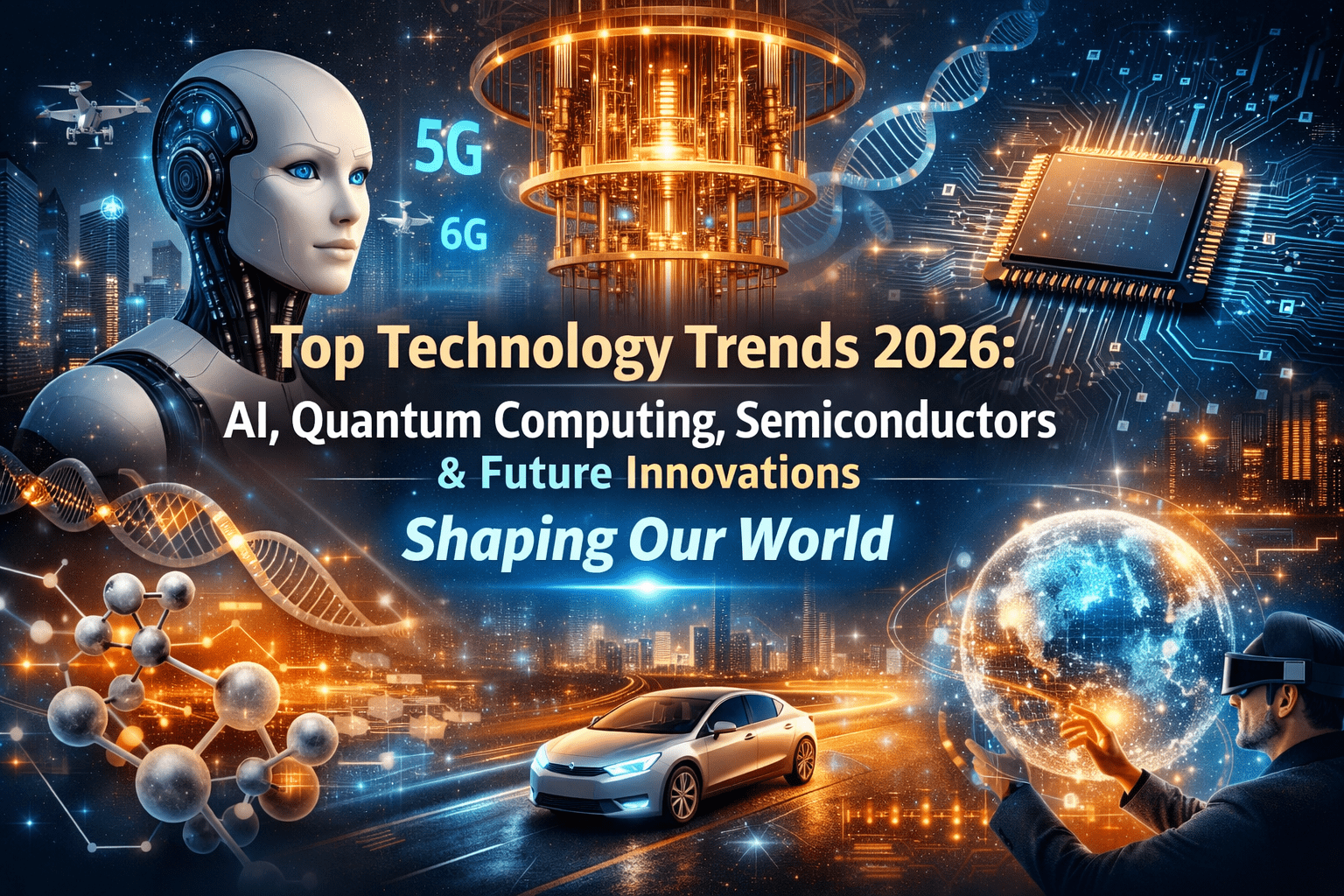
Technology continues to advance at a rapid pace, reshaping industries, redefining human experiences, and demanding new regulatory, ethical, and societal frameworks. In 2026, these transformations are more visible and impactful than ever before — from artificial intelligence that thinks and acts autonomously, to hardware innovations revealed at major global tech shows, to emerging computing paradigms like quantum machines promising profound disruptions.
In this exclusive technology news blog, we explore the most important stories, trends, innovations, and implications shaping tech today. This report delves deep into cutting‑edge developments affecting AI, semiconductors, computing, consumer tech, enterprise infrastructure, connectivity, healthcare tech, and future innovations that could redefine our world.
1. CES 2026: Global Tech Unveiled
Top Technology Trends 2026
The World’s Biggest Tech Show Sets the Tone for 2026
The Consumer Electronics Show (CES) in Las Vegas is widely regarded as the official kickoff of each year’s tech cycle. In January 2026, CES once again delivered a deluge of announcements, previews, prototypes, and innovations from major companies and startups alike — revealing where the next 12–24 months of innovation are heading.
AI Everywhere — From smart appliances to chips and mobile devices, artificial intelligence featured at nearly every booth. Several companies showcased AI‑driven experiences, tools, and platforms designed for both everyday consumers and enterprise users.
AI at the Edge & IoT Platforms — Innovations in low‑power edge AI chips promise to bring intelligent processing directly into devices like wearables, smart home hubs, and robotics.
Next‑Generation Connectivity — Advances in Wi‑Fi systems, wireless standards, and edge networking were major themes, signaling that connectivity will be as competitive as core AI this year.
Key Announcements from CES 2026
Top Technology Trends 2026
Semiconductors and AI Chips
One of the most competitive arenas at CES was semiconductor design and AI compute infrastructure. Industry leaders like Nvidia, AMD, and others showcased platforms designed for next‑gen workload acceleration:
Nvidia’s next‑generation AI rack compute system (e.g., Rubin architecture) is engineered for intense reasoning and inference workloads that support agentic AI at scale.
AMD revealed its Helios data center platform, designed to rival dominant GPU‑based racks in high‑performance AI tasks.
These moves underscore how the future of AI isn’t just software — it’s about highly integrated hardware systems that support huge datasets, real‑time processing, and continuous learning capabilities.
Consumer Tech Highlights
CES 2026 also flagged mainstream tech trends that will affect everyday consumers:
AI Karaoke Speakers — Innovative audio systems with built‑in voice‑processing AI that can isolate vocals, adjust pitch, and create immersive music experiences.
Enhanced Gaming and Wearables — Smart gaming hardware, high‑resolution displays, and immersive accessories that push performance without compromising usability.
Practical AR Glasses — Affordable augmented reality glasses that expand workspace and entertainment applications beyond mobile screens.
2. Artificial Intelligence: From Assistants to Autonomous Agents
Top Technology Trends 2026
AI Trends That Will Define 2026
Artificial intelligence remains the centerpiece of technological transformation in 2026. While generative AI captured headlines globally, the current frontier is agentic AI — systems capable of setting goals, planning, and executing tasks with minimal human intervention.
Agentic AI Explained
Unlike early AI models that needed explicit prompts or queries, agentic AI can:
Identify objectives
Operate independently across multiple systems
Engage in planning, execution, and iteration without constant human guidance
This evolution is significant because it elevates AI from a tool to a digital workforce. Early applications are already emerging in enterprise automation, customer service systems, autonomous logistics, and software engineering.
AI’s Commercial and Creative Expansion
In addition to agentic systems, AI continues expanding across industries:
Healthcare AI platforms are reshaping diagnostics and personalized medicine, particularly when combined with genomics and bioinformatics tools.
Creative industries are using generative AI for content production, design, and storytelling, accelerating workflows. (Historical context on generative AI advancements.)
AI Governance and Ethical Considerations
As AI grows more autonomous and embedded into society’s infrastructure, governance issues are coming to the forefront — particularly around accountability, bias, transparency, and privacy.
Leading technology organizations and policymakers are increasingly focused on creating frameworks that ensure AI systems are trustworthy, explainable, and aligned with human values. This trend represents not just technological maturity, but societal awareness of AI’s impact.
3. Computing at the Edge and the Rise of Hybrid Architectures
Why Edge AI Matters
Traditional computing models rely on centralized cloud servers for processing. However, with the explosion of data generated by millions of connected devices, two computing paradigms are emerging:
Edge Computing — Process data directly on or near the devices generating it (like sensors, wearables, vehicles).
Hybrid Cloud/Edge Systems — Seamlessly balance workloads between cloud data centers and edge nodes.
Edge computing helps reduce latency, lower bandwidth costs, and enable real‑time responsiveness — critical features for autonomous vehicles, smart infrastructure, and critical industrial applications.
Integration with Internet of Things (IoT) and 6G
IoT ecosystems are rapidly expanding, and next‑generation connectivity technologies like 6G promise speeds and responsiveness far beyond 5G. While 6G deployment is still in early stages, initial developments focus on extremely low latency, high device density, and adaptive network intelligence — creating a fertile ground for edge AI and pervasive computing.
This convergence is paving the way for truly connected smart cities, advanced telemedicine platforms, and industrial digital twins that can operate autonomously even in disconnected environments.
4. Quantum Computing: Beginning of Real‑World Impact
Quantum Technologies Moving Beyond Theory
For years, quantum computing was seen as a futuristic concept — promising immense computational power but difficult to realize. Recent progress suggests that the “quantum promise” is starting to materialize into tangible advantages in select domains.
Quantum machines excel at problems involving:
Complex molecular simulations for material science and pharmaceuticals
Optimization problems with massive parallel search spaces
Secure communications through quantum key distribution
In 2025 and into early 2026, practical quantum applications began emerging, particularly in pharmaceutical research and advanced cryptography.
Commercial and Security Implications
While broad quantum adoption is still years away, progress now influences how institutions think about data security — especially with the looming reality that future quantum computers could break many forms of existing encryption.
Quantum‑safe cryptographic protocols are now high priorities for governments and enterprise cybersecurity teams.
5. Semiconductors: The Heartbeat of Tech Innovation
Semiconductor Trends to Watch
Semiconductors are the core infrastructure underlying AI, mobile computing, cloud services, networking, and future innovations. As demand grows, new trends are shaping the industry:
Ultra‑Low‑Power AI SoCs (System on Chips) for edge devices enable smart sensors and autonomous robotics to function without constant cloud dependency.
AI‑Optimized Data Center Chips are designed to accelerate inferencing and reasoning tasks at massive scale.
Resilience and Supply Chain Security — Countries and companies are investing in diversified manufacturing to reduce reliance on single sources.
This expansion is not just technical but geopolitical, as semiconductor sovereignty becomes a priority for economic and national security.
6. Health Tech: Where Biology Meets Digital Intelligence
AI and Healthcare Innovation
Healthcare technology is undergoing a profound shift. AI‑powered diagnostic tools can interpret medical imaging, analyze genetic data, and support clinical decisions with speed and accuracy far beyond human capabilities.
Additionally, AI is enabling:
Predictive models for disease outbreak tracking
Personalized treatment recommendations
Enhanced drug discovery pipelines
These technologies promise not only better care but also lower costs and increased accessibility worldwide.
Biotech Convergence
AI is merging with biotechnology, fostering breakthroughs in areas like synthetic biology, CRISPR‑driven gene editing, and biologically informed computation. These hybrid technologies could eventually transform how we approach disease prevention and human enhancement.
7. Consumer Tech: Practical and Smart Devices for Daily Life
Tech You Can Use Today
Beyond laboratories and corporate labs, some of the most exciting innovations are consumer gadgets that enhance daily living:
AI‑powered wearable devices that monitor health metrics and provide dynamic feedback
Smart home systems with predictive automation and voice‑less AI control
Augmented reality gadgets that enrich entertainment and productivity experiences
These products are not only gadgets — they reflect how digital intelligence will become ubiquitous, intuitive, and personalized.
8. Connectivity and the Future of Networks
The Road to 6G and Beyond
While 5G continues to expand, research and early testbeds for 6G are already underway. 6G technology is expected to enable unprecedented data speeds, network intelligence, and real‑time system coordination, unlocking transparent immersive experiences across massive IoT ecosystems.
Network Security and Sovereignty
Enhancing connectivity also brings security challenges. Emerging tech news highlights growing investments in quantum‑safe networking protocols, AI‑enhanced network defense systems, and distributed trust models to defend critical infrastructure.
9. Cybersecurity: A Rising Priority
With technology deeply embedded in daily life and organizational operations, cybersecurity has become more critical than ever. As attacks become more sophisticated, defenders are harnessing AI to anticipate, detect, and neutralize threats.
However, cybersecurity itself now faces an AI arms race: malicious actors can use AI to generate highly convincing phishing schemes, automate exploit discovery, and scale attack campaigns.
This dual use of AI underscores the urgent need for robust digital defenses, human expertise, and ethical safeguards.
10. Ethics, Policy, and the Human Side of Technology
Advanced technologies aren’t just technical systems — they are socio‑technical systems with real societal implications. In 2026:
AI governance frameworks are being proposed to ensure accountability, fairness, and transparency in automated decision‑making.
Data privacy laws are being reconsidered in light of pervasive AI tracking and analysis capabilities.
Responsible innovation models are emerging that balance technological progress with human dignity and equity.
These discussions are foundational to building technology that benefits humanity broadly, not just a select few.
Conclusion: A Connected, Intelligent Future
As we move through 2026, it’s clear that technology is no longer an external force — it’s an integrated part of life, industry, and society. From agentic AI platforms that can act autonomously, to advanced chips that power enormous compute systems, to quantum advancements reshaping cryptography, the pace of innovation is unrelenting.
This technology news blog has traced the most significant developments and teased the trends that will dominate tech discourse in the coming months. The world is navigating a rapid shift toward computational intelligence, ubiquitous connectivity, and hybrid physical‑digital experiences — a shift that brings unprecedented opportunity, challenge, and responsibility.
Visit My Page (Click Here)