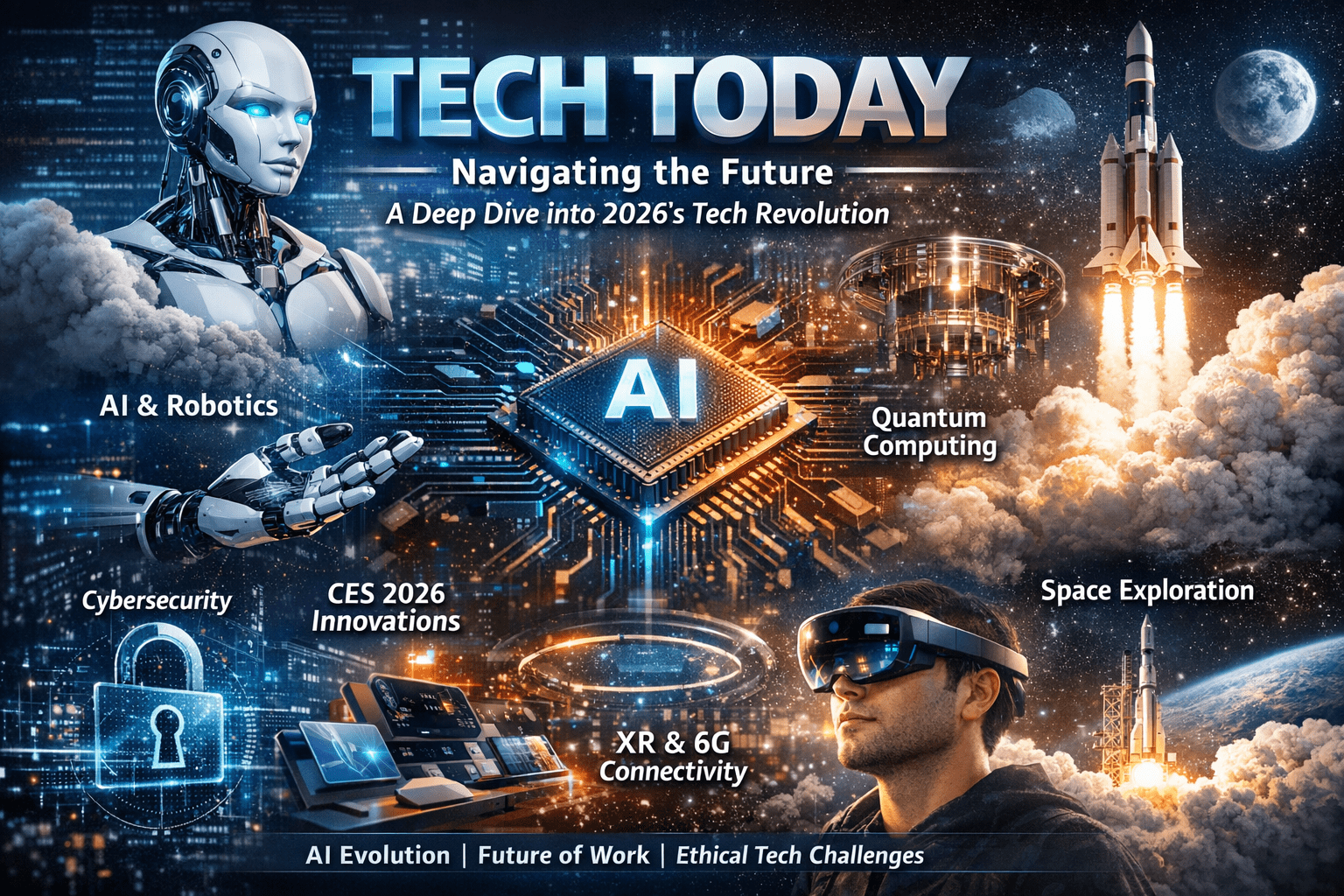
TECH TODAY Navigating the Future 2026
From breakthroughs in artificial intelligence to innovations at CES 2026, the technological landscape is advancing faster than ever. In this blog, we unpack the major technology developments shaping industries and everyday life — including AI, cybersecurity, semiconductors, robotics, space exploration, and global tech trends.
This long‑form article is organized into key themes so you can explore what matters most — whether you’re a developer, entrepreneur, student, or curious reader.
1. The AI Revolution of 2026: Beyond Chatbots to Context‑Aware Intelligence
TECH TODAY Navigating The Future 2026
Artificial intelligence remains the most transformative force in tech. What started as simple chat interfaces has grown into systems capable of complex tasks, autonomous decision‑making, and deep integration into digital life.
AI Evolving from Task Tools to Deep Integration
In recent years, AI has shifted from standalone applications to becoming a core layer of computing across systems and devices. In 2025 and into 2026, this transition accelerated: AI is now deeply embedded in operating systems, cloud platforms, mobile devices, and software workflows, making technology proactive rather than reactive.
Tech industry analysts note this shift reshapes how we interact with devices — AI no longer waits for prompts but anticipates needs, summarizes content, automates tasks, and optimizes workflows without explicit direction.
Agentic AI: Autonomy in Action
One of the biggest breakthroughs is the rise of agentic AI — systems that don’t just respond to inputs, but take actions on behalf of users. Unlike previous chat‑style AI, agentic models can interact with applications, manage data, and coordinate workflows autonomously across platforms.
Businesses are already piloting these AI agents to handle sophisticated tasks like scheduling, customer support automation, and even software development support, indicating a shift toward AI as a digital workforce rather than a simple assistant.
Major AI Innovation News
OpenAI’s first AI hardware device is expected to launch in the second half of 2026, signaling the company’s move beyond software into custom AI products.
Samsung announced a strategy focused on seamless AI integration, embedding intelligence into everyday products rather than standalone gadgets — from smart appliances to intuitive AI features in mobile devices.
These developments suggest companies are betting not just on powerful models, but on AI that blends into lives and environments — making intelligent assistance ubiquitous and invisible.
2. Semiconductors, Computing, and the Race for Performance
TECH TODAY Navigating The Future 2026
At the foundation of modern technology lies computing hardware — and 2026 is seeing breakthroughs that will determine capabilities for years to come.
Semiconductor Innovations
Industry researchers recently published trend reports highlighting how semiconductor innovation is central to everything from AI acceleration to edge computing and advanced robotics.
With global demand for AI‑optimized chips, companies are investing heavily in next‑generation silicon, specialized accelerators, and heterogeneous compute architectures that blend CPUs, GPUs, custom AI ASICs, and even quantum capabilities.
AI Supercomputing Platforms
Gartner’s top strategic trends for 2026 include AI supercomputing platforms — powerful integrated systems that unify multiple computing paradigms to handle complex AI workloads efficiently and at scale.
These platforms support high‑performance analytics, machine learning training, simulations, and digital twin models essential for industries like finance, healthcare, and autonomous vehicles.
Quantum Computing: Promise and Peril
Quantum computing continues to evolve from theory to strategic investment. Nations and companies are pushing for functional quantum systems capable of solving complex problems beyond classical computing reach. In India, initiatives under the National Quantum Mission led to the development of a 25‑qubit quantum computer system, showing progress in quantum readiness.
However, the rise of quantum also presents risks — especially for encryption. Financial authorities and exchanges warn that quantum computing could eventually disrupt current cryptographic systems used for secure transactions and data protection, requiring quantum‑safe encryption strategies.
3. Robotics and Physical AI: Bringing Brains to Machines
TECH TODAY Navigating the Future 2026
Artificial intelligence isn’t confined to software — it’s now powering real‑world robotics and autonomous machines, a trend analysts call Physical AI.
Advanced robots can now perceive environments with more context, make decisions, and interact safely around humans — a paradigm shift from traditional pre‑programmed machines.
Industries like manufacturing, logistics, healthcare, and agriculture are already benefiting from intelligent robotics that automate tasks, adapt to unpredictable settings, and collaborate alongside human workers.
As Physical AI evolves, it will reshape workflows, require upskilling of workforces, and demand new frameworks for safe human‑robot collaboration.
4. CES 2026 Highlights: Gadgets, Hardware, and the Future of Consumer Tech
Each year, CES (Consumer Electronics Show) unveils cutting‑edge hardware — and 2026’s event was no exception. Here are the standout takeaways:
Next‑gen gaming gear and displays like QD‑OLED monitors and hybrid laptops proved that hardware innovation continues full force.
Autonomous driving tech, such as advanced radar perception platforms built with NVIDIA compute, showcased real‑world AI hardware capabilities for automotive AI.
Trend predictions from CES emphasized not only AI and automation, but also immersive experience tech and health‑oriented electronics.
These products and demonstrations signal that hardware and software are converging with AI at the core — from gaming rigs to everyday gadgets that incorporate intelligent features.
5. Cybersecurity in the AI Era: Rising Threats and Defense
As digital systems grow smarter, attackers are also leveraging new technologies, making cybersecurity a critical battleground in 2026.
Exploding Cyber Risk Landscape
In India alone, organizations faced millions of cyberattacks weekly in 2025, with incidents trending upward as AI becomes integral to enterprises. Experts warn that AI greatly increases attack sophistication — enabling faster reconnaissance, automation of phishing, and customized exploit tools.
AI‑Driven Threat Evolution
Cybersecurity professionals predict that AI‑augmented attacks will become more common in 2026, requiring new defense models that anticipate threats rather than react only after breaches occur.
This has catalyzed investment in preemptive cybersecurity, which uses AI to spot vulnerabilities and threats before they unfold — an important trend in enterprise security strategies.
Educating for Defense
Organizations are focusing more on zero‑trust architectures, continuous identity verification, and automated threat hunting to counter next‑gen threats. Individuals and firms alike must prioritize cybersecurity literacy as integration of digital tools expands into every sector.
6. Extended Reality (XR), Wearables, and Human–Computer Interaction
Extended Reality — spanning AR (Augmented Reality), VR (Virtual Reality), and MR (Mixed Reality) — continues to grow beyond gaming into work, training, and everyday interaction.
XR systems are now used for remote collaboration, immersive education, and virtual prototyping, pushing the boundaries of how we experience digital content.
Meanwhile, wearable technology integrates sensors, health tracking, and on‑device intelligence, creating seamless interactions between humans and digital systems. Research indicates that wearables are rapidly evolving to support real‑time contextual assistance, health monitoring, and adaptive interfaces.
7. Edge, 6G, and the Future of Connectivity
Connectivity technologies like Edge AI and tomorrow’s 6G wireless networks promise ultra‑low latency, localized computing power, and new services that integrate AI and communications fluidly.
Edge AI prioritizes processing at or near the device to reduce latency and protect privacy, enabling real‑time decision‑making in smart devices and IoT ecosystems.
Research continues into 6G systems that may further accelerate data throughput and connectivity with integrated AI — unlocking possibilities for autonomous systems, smart infrastructure, and next‑generation digital experiences.
8. Space Tech and Quantum Missions: Expanding Frontiers
Beyond Earth, technology is advancing humanity’s reach into space — from lunar missions to reusable rockets.
NASA’s Artemis II, a crewed lunar flyby mission, is scheduled for launch in 2026, a significant achievement in deep space exploration.
At the same time, reusability in space launch systems — especially for reducing mission costs and increasing launch cadence — remains an important research and development focus.
9. The Future of Work: Reskilling, AI Fluency, and Human‑Tech Synergy
As AI and automation reshape job roles, organizations must invest in reskilling workers so humans and machines complement each other.
AI fluency — understanding how to work with AI tools — is now an essential skillset. Whether you’re in design, marketing, operations, or engineering, being able to collaborate with intelligent systems confidently will define success in the coming decade.
10. Closing Thoughts: Tech’s Responsibility and Ethical Frontier
TECH TODAY Navigating The Future 2026
With innovation comes responsibility. As technology becomes more pervasive and powerful, questions about privacy, bias, ethics, regulation, and human agency must be addressed thoughtfully.
From AI‑generated content and deepfakes to autonomous decision‑making systems, society must develop frameworks that harness technology’s potential while mitigating risks.
Conclusion: A New Technological Era
2026 isn’t just another year in tech — it’s a defining moment where AI and computing converge with real world systems, reshaping industries, daily life, and our understanding of what’s possible.
Whether you’re an industry leader or a curious reader, this transformational period offers unprecedented opportunities — and challenges — for everyone.
Keep watching, experimenting, and learning — because the future is here, and it’s powered by technology.
Visit My Page (Click Here)